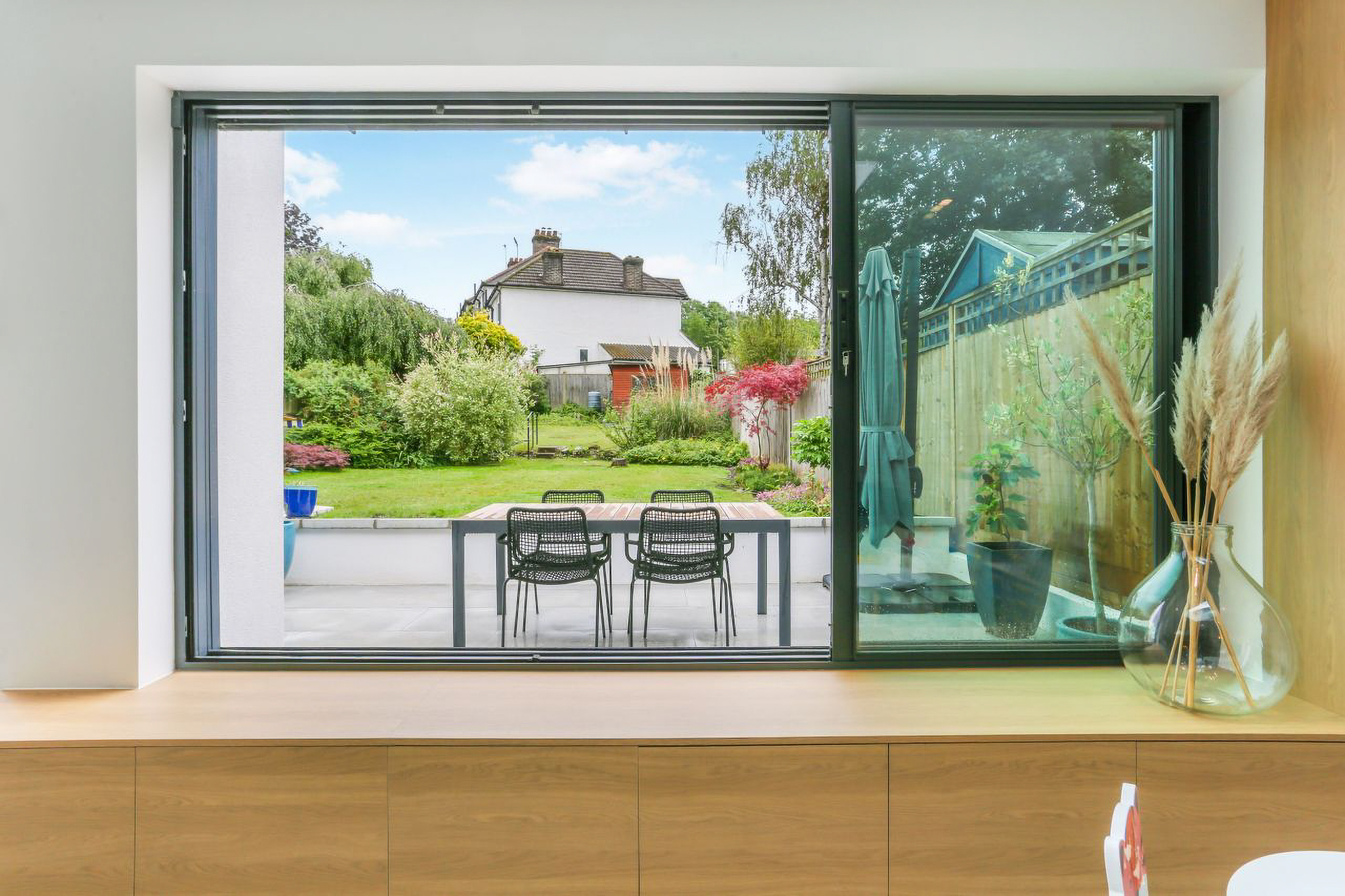
Minimal Sliding Window with matching doors in South Croydon
This gorgeous project in South Croydon, manufacturing a minimal sliding window with matching doors. Designed by KJC Architects.
Read the StoryYour front door does more work than any other part of your home. It keeps heat in, weather out and you expect a good front door to keep your home secure. Depending on your property style, a good front door sets the tone for the entire property before anyone steps inside. Yet most homeowners doing property renovation projects, in our experience often leave the front door as the last item to replace, if at all.
That is understandable. The front door market in 2026 can appear very complicated. Not only are there around five materials to choose from, but also doors now come in more than just standard door hinges. A growing list of performance standards that govern everything from security testing to thermal efficiency and meeting disability requirements may also affect your choice of front door.
Whether you are replacing a tired uPVC panel, specifying a statement entrance door for a new build, or exploring modern front door options for a renovation, the fundamentals are the same.
What follows is our expert knowledge of all major door types and materials available to you in 2026. We will explain the standards that matter, compare your options fairly, and help you work out which combination suits your home, your budget and your project priorities.
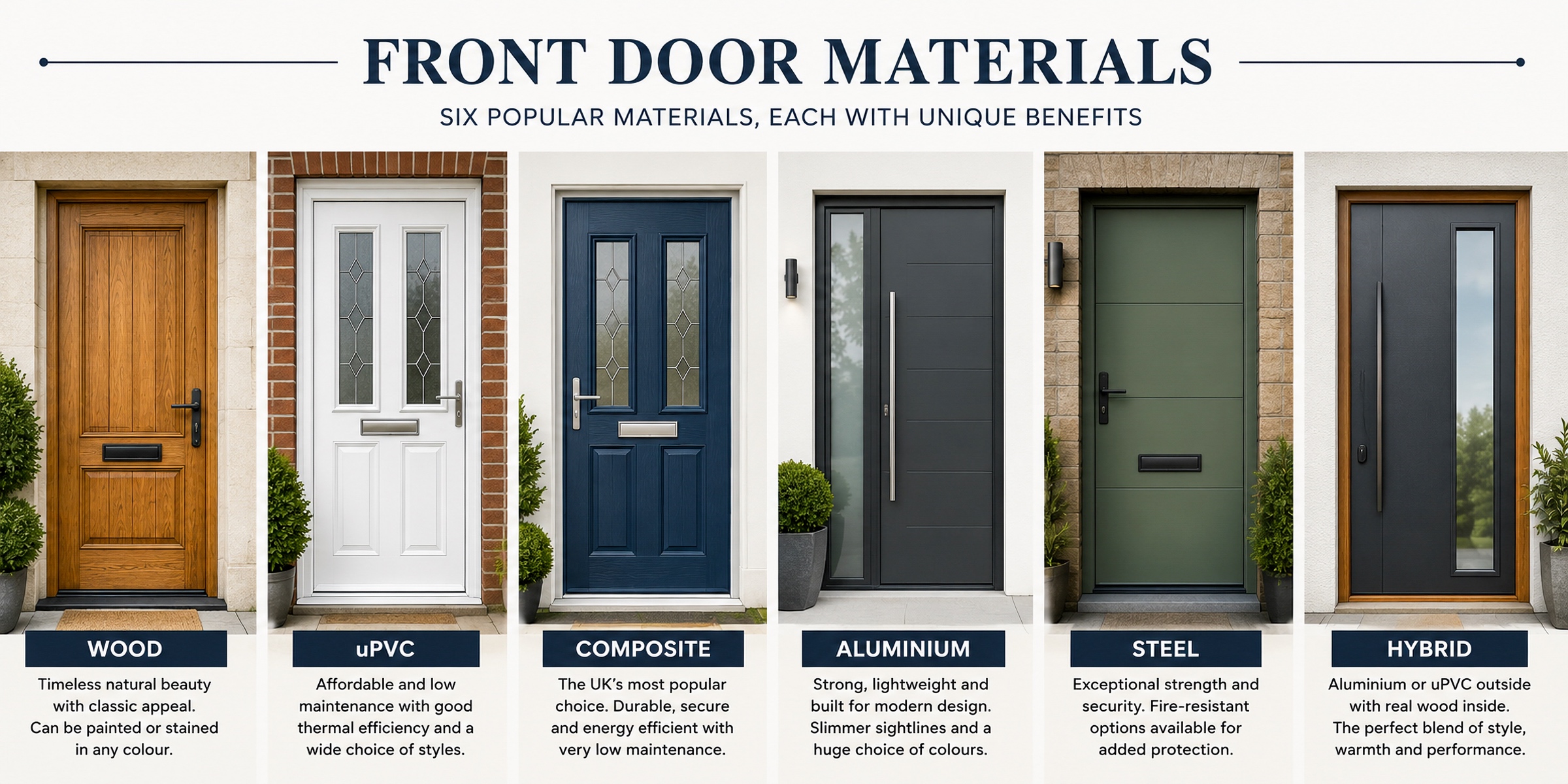
Before choosing a material or a style, it helps to understand what every front door needs to deliver. Regardless of whether you spend several hundred pounds or ten thousand, the fundamentals are the same.
Security is the starting point. Your front door is the most targeted entry point for burglars, according to research. A good entrance door resists forced entry through its frame, its locking system and the door leaf itself. The benchmark in the UK is PAS 24, a pass-or-fail security standard that tests the complete doorset against common break-in methods including levering, lock manipulation and physical impact.
It does not matter what material your door is made from, the pass-or-fail criteria remain the same.
For new-build homes, PAS 24 compliance is required under Part Q of the Building Regulations. For replacement doors in existing homes it is not legally mandatory, but it is the clearest way to verify that a product has been independently tested.
Thermal performance is measured by U-value. This is the rate at which heat passes through the door, expressed in watts per square metre per kelvin (W/m²K). The lower the number, the better the insulation. Under current Building Regulations (Part L), replacement doors in existing homes should achieve a U-value of 1.6 W/m²K or better. New-build doors must hit tighter targets – typically 1.0 W/m²K for solid doors and 1.2 W/m²K for doors with more than sixty percent glazing. The limiting U-value under Part L is 1.6 W/m²K, though the target for replacement doors is 1.4 W/m²K – aim for the target, not just the limit. The forthcoming Future Homes Standard will tighten these figures further.
Weather resistance covers how the door performs against wind, rain and air infiltration. Performance is tested to British Standards and rated in classes: wind resistance (Class 1–5), water tightness (rated in Pascals – the higher the better) and air permeability. These ratings matter most in exposed locations, coastal properties and south-facing elevations where driving rain is a persistent issue.
Durability determines how well the door holds up over ten, twenty or thirty years. Every type of front door will need maintenance at some point during its life. Some materials need more frequent inspection than others, to stay functional and attractive. No door is fit-and-forget. Neither approach is wrong, but you need to know what you are signing up for.
Six materials dominate the UK entrance door market. Each has genuine strengths and genuine limitations. What follows is an honest assessment of all five.
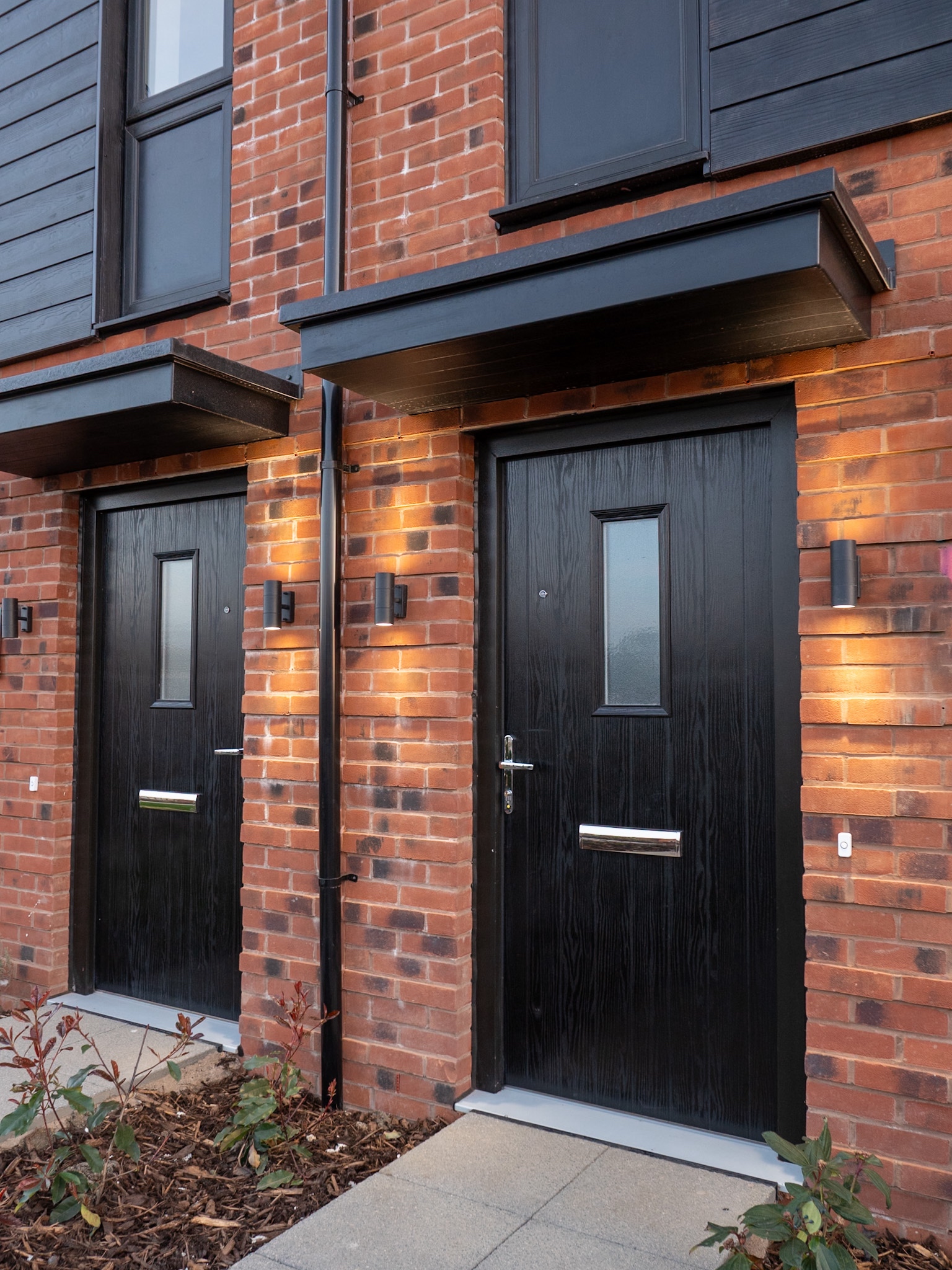 Composite doors have become the most popular choice for UK residential front doors, and it is easy to see why. The construction combines a glass-reinforced plastic (GRP) outer skin with an insulating foam or solid timber core, set within a reinforced frame. The result is a door that resists weathering, requires almost no maintenance and offers strong thermal and security performance out of the box.
The GRP skin can be moulded to replicate timber grain patterns, so composite doors are available in a wide range of traditional and contemporary styles. Colour options have expanded significantly over the years alongside the styles. Popular colours today include anthracite grey, Chartwell green and a range of woodgrain finishes are now standard alongside the classic whites and blacks. Many manufacturers offer different colours inside and out. Most composite doors use a reinforced uPVC frame, although some premium systems use alternative frame constructions.
On the security front, composite doors typically come fitted with multi-point locking systems and are widely available with PAS 24 certification. Thermal performance is strong, with most quality composite doors achieving U-values between 1.0 and 1.4 W/m²K.
Cheaper composite doors can show surface fading after a very short period of time, especially on south-facing elevations and years of direct sunlight exposure. The moulded woodgrain finish, while convincing at a distance, does not have the depth or variation of real timber. Chips in the GRP skin are difficult to repair invisibly. And although they suit almost any property style, the faux grain can look out of place on high-end contemporary homes where a cleaner, flatter finish is preferred.
Lower-cost composite doors often use a foam-insulated core, while more premium systems may use a solid timber core or more advanced core construction. Some composite doors can experience movement over time depending on exposure, installation quality and core construction.
£900–£2,500 supplied and fitted.
Most UK homes and frequently used by developers. Often purchased as an affordable option for a new front door. The more expensive the door, the better it tends to be. They suit the homeowner who values a balance of performance, appearance and cost.
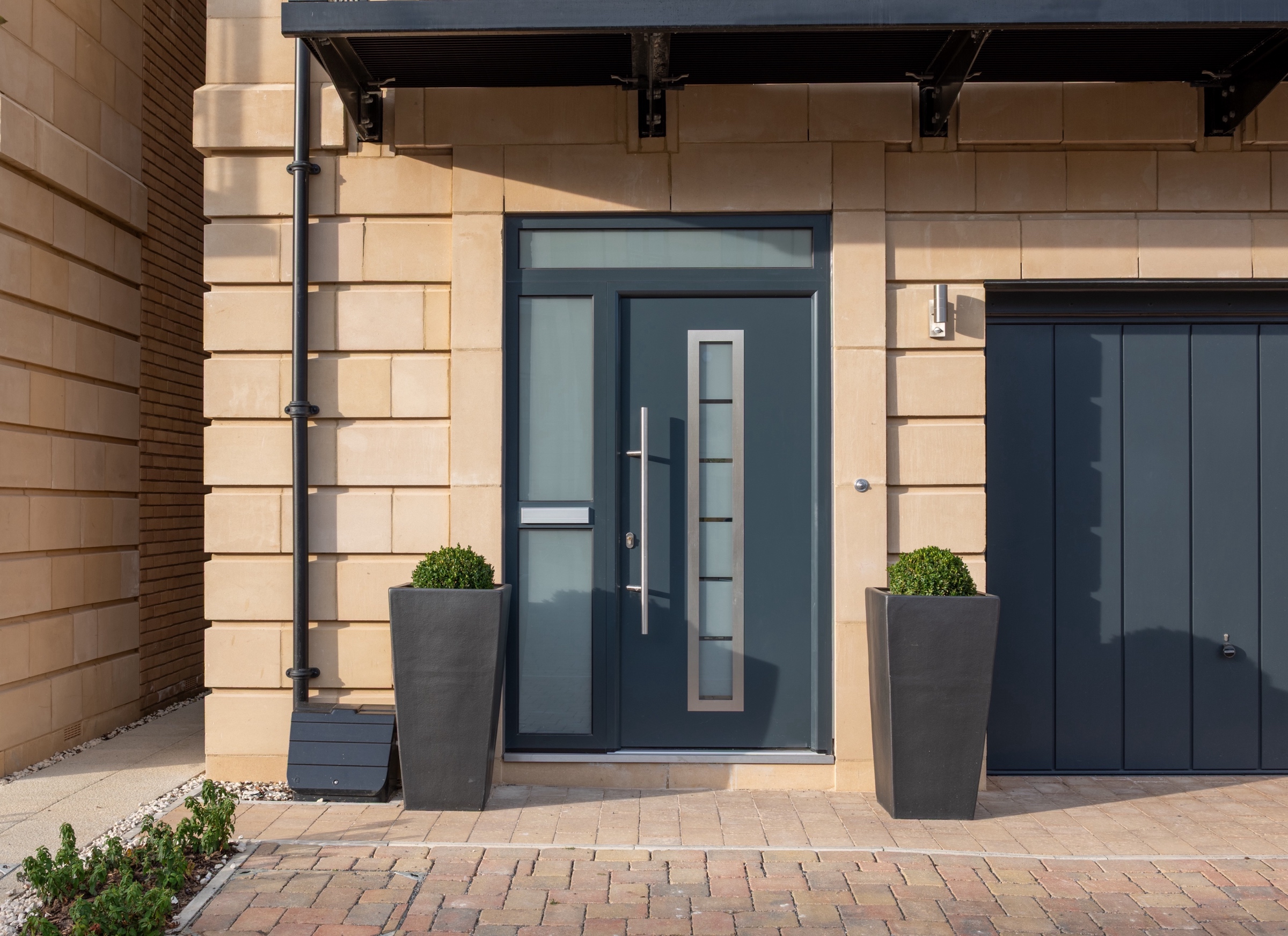
Aluminium entrance doors sit at the premium end of the market. The material's inherent strength allows for slimmer frame profiles and clean sightlines that are difficult to achieve with other materials.
Aluminium doors are powder-coated rather than painted, which means the finish is factory-applied, consistent and highly durable. There is a choice of over 150 RAL colours and better guarantees against fading, however routine cleaning is recommended to keep the finish looking its best for years.
At Glideline we also provide a wood-effect finish for our aluminium doors. Contact us for more information and a colour swatch.
Modern aluminium doors use thermally insulated profiles to prevent heat transfer through the frame. This means they can achieve excellent U-values despite being a metal. Security is another natural strength. Aluminium is rigid, strong and difficult to force. Many aluminium entrance door systems are available with PAS 24 and Secured by Design accreditation for additional peace of mind.
Cost. Aluminium front doors are more expensive than composite or uPVC doors, but they are also positioned higher in the market in terms of design, specification and longevity.
If your doors are in a city centre, swimming pool or coastal location, it is worth considering upgrading the paint finish to cover these more demanding environments and cleaning becomes more important as well to remove contaminants.
£1,800–£5,000+ supply and fit, depending on the type and brand.
Contemporary homes, modern new-build entrances, renovation projects with oversized openings, and properties where a clean, modern aesthetic matters. Also, the go-to material for pivot doors and large-format entrance door designs.
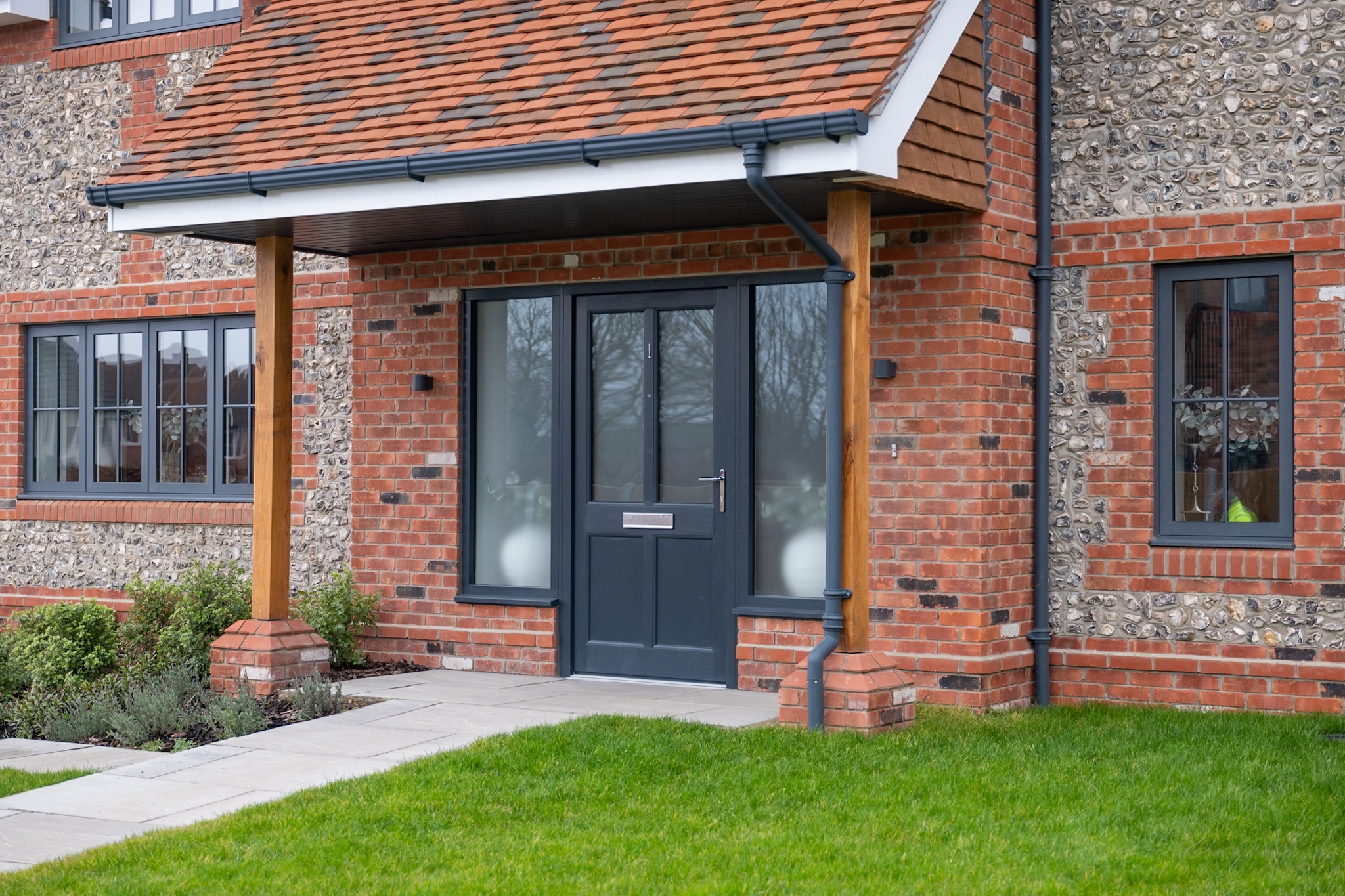
Nothing quite matches the look, feel and sound of a solid timber front door. Timber is the only entrance door material that genuinely improves with age when properly maintained. A well-kept hardwood door develops character over decades, and it is the only material you can sand back and refinish in a completely different colour ten years down the line.
Hardwoods like oak, iroko and Accoya are the premium choices. Accoya in particular has gained ground in recent years because it is acetylated to resist rot, swelling and shrinkage far better than traditional hardwoods, making it well suited to the UK climate. Softwood doors (typically redwood or pine) are cheaper but less durable and more maintenance-intensive.
Timber doors offer strong thermal performance naturally, and a solid hardwood door with proper seals and glazing can achieve U-values that rival composite. Security-wise, a dense hardwood door leaf is extremely difficult to force, and timber doorsets are available with PAS 24 certification from several specialist manufacturers.
Where they fall short
Maintenance. Timber doors do need periodic inspection to ensure the paint finish is in good condition. Whilst not maintenance free, modern wood and paint materials mean timber doors do last longer.
However, neglect it and the door will show its age quickly, potentially developing peeling finishes, swollen edges and movement within the frame as the timber expands and contracts. This is a material for homeowners who are willing to invest time as well as money. However, the better the brand, the better your new wood door will perform over time.
Typical cost: £2,000–£6,000+ supply and fit
Best suited to: Period properties, conservation areas, listed buildings and homes where authenticity matters. Also popular for high-end contemporary timber-clad properties.
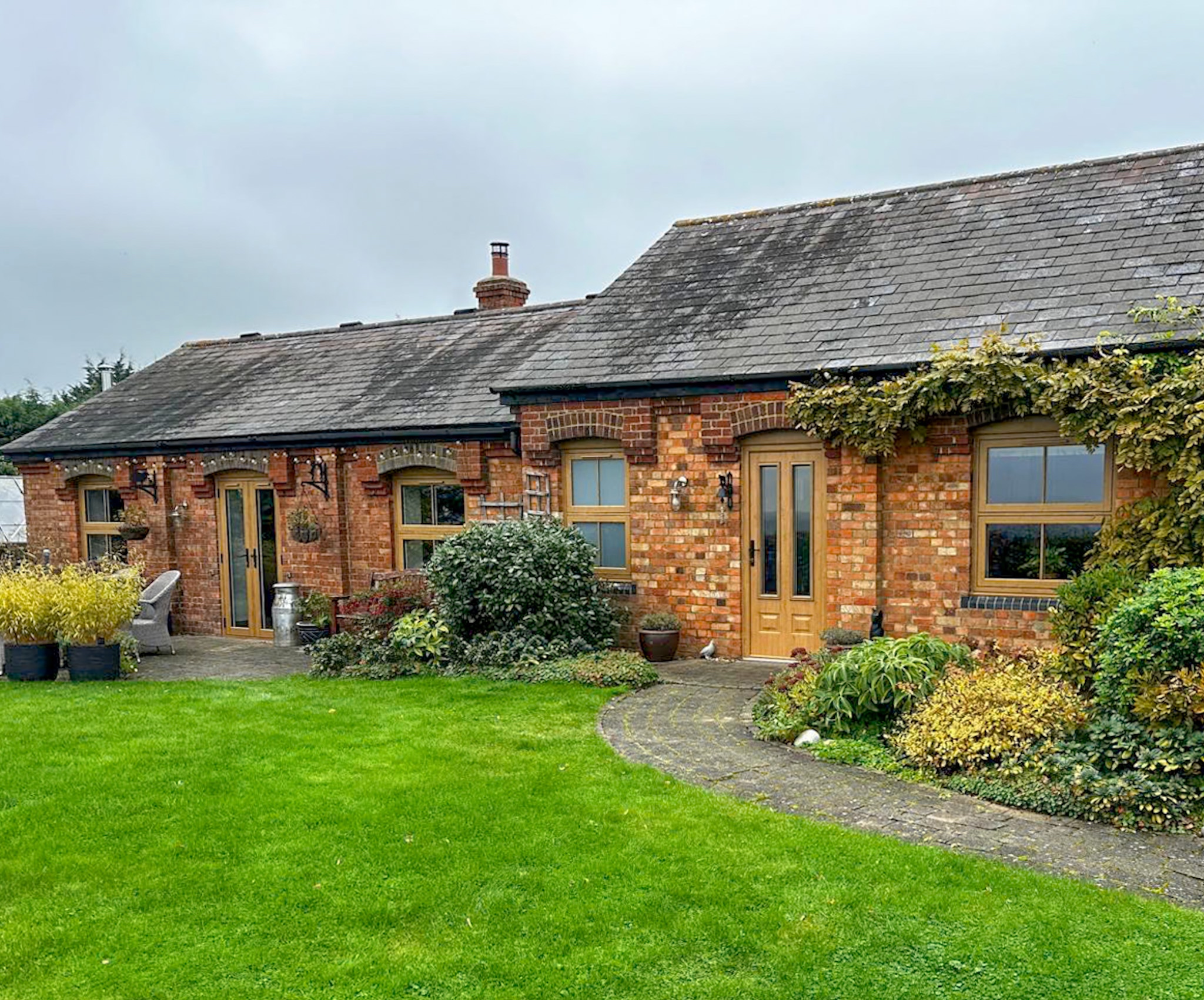
uPVC is the most affordable mainstream entrance door material in the UK. It offers good basic performance at a fraction of the price of composite or aluminium, and it requires virtually no maintenance beyond occasional cleaning. Modern uPVC doors have improved considerably, with wider colour ranges, multi-point locking systems and respectable thermal performance.
uPVC doors are fine for side and back doors, and this is reflected in the price. For front doors, do be aware that many of these use a simple glaze-in method for the decorative panel Older or lower-cost uPVC entrance doors can feel less rigid than composite, timber or aluminium alternatives, particularly where decorative panel systems are used.
Typical cost: £800–£1,500 supply and fit.
Best suited to: Budget-conscious homeowners, rental properties, and modern homes where a clean, simple appearance is acceptable. A sensible choice when the priority is performance per pound. uPVC remains the cheapest available front doors.
Steel entrance doors occupy a niche but growing segment of the UK market. Some specialist steel doors achieve higher security classifications beyond PAS 24, including SR-rated systesms used in high security applications. Bespoke steel doors can be finished in any RAL colour, and the flat, smooth surface accepts clean contemporary designs as well as more traditional panelled configurations. Thermal and acoustic performance is also good.
Steel entrance doors are the most expensive option in the market. They require specialist manufacturing and installation, and lead times tend to be longer than for other materials.
Typical cost
£3,000–£8,000+ supply and fit.
Best suited to
Premium new builds, apartment entrance doors where fire ratings are required, and properties where maximum security is the primary concern.
Hybrid front doors are not to be confused with composite doors. These are premium doorsets with aluminium or uPVC outside and real wood on the inside, offering low-maintenance exteriors with the warm-to-the-touch nature of real wood internally. They are PAS 24 security tested and come either with solid panels or a combination of glass and panel. They can be finished in any RAL colour outside with natural, stained or painted wood inside.
Hybrid doors are more expensive and work better with matching hybrid windows. The panel styles are usually more limited than other brands as well.
£2,000–£6,000+ supply and fit.
Best suited to: Premium new builds, apartment entrance doors where you want timeless wood inside with aluminium outside.
| Composite | Aluminium | Timber | uPVC | Steel | Hybrid |
|---|---|---|---|---|---|---|
Security | Excellent | Excellent | Very good | Good | Excellent | Excellent |
Thermal | Very good | Very good | Good–Excellent | Good | Very good | Excellent |
Maintenance | Very low | Very low | High | Very low | Low | Low |
Durability | 25–30 yrs | 30+ yrs | 60+ yrs* | 20–25 yrs | 30+ yrs | 30+ yrs |
Cost (fitted) | £900–£2,500 | £1,500–£5,000+ | £2,000–£6,000+ | £800–£1500 | £3,000–£8,000+ | £3,000–£6,000+ |
Aesthetic range | Traditional–Contemporary | Contemporary | Traditional–Contemporary | Moderate | Traditional–Contemporary | Traditional–Contemporary |
Most front door guides focus exclusively on materials, but how your entrance door opens matters just as much as what it is made from. Different mechanisms suit different homes, different lifestyles and different architectural styles.
The hinged door is the default for UK homes. The door leaf is mounted on side hinges and swings inward or outward on a vertical axis at the edge of the frame. It is available in every material, at every price point, and with the widest range of hardware, glazing and panel options.
Standard single-leaf hinged doors are manufactured to stock sizes or bespoke and made to order. Composite doors can be more limited in narrow or unusual sizes, particularly for cottages or older terraced houses. Double-leaf hinged doors use two leaves that meet in the centre, available as equal or unequal pairs, with one primary and one secondary leaf chosen at time of order.
For most UK homes, a single-leaf hinged door in composite or aluminium will be the right choice.
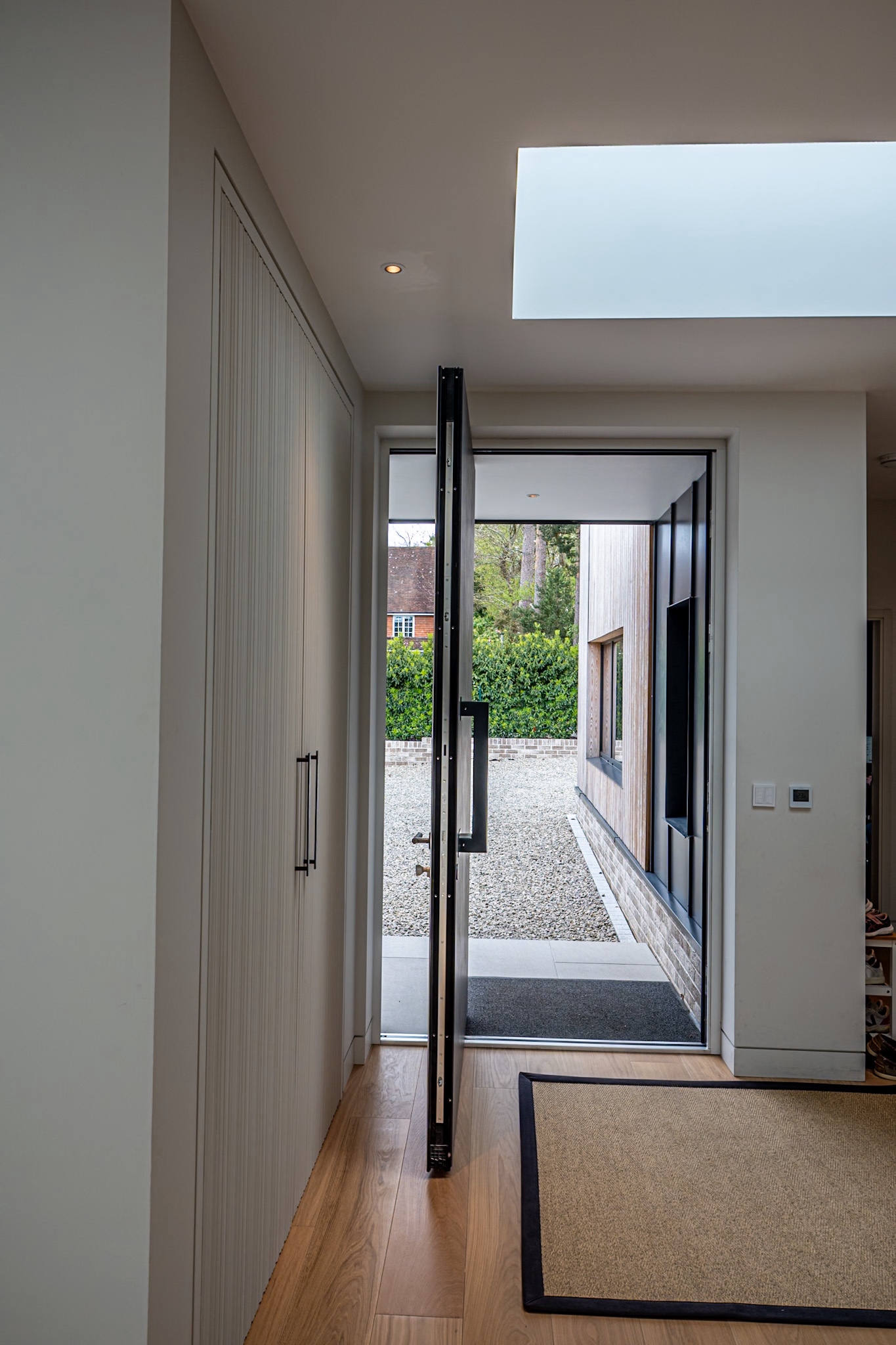
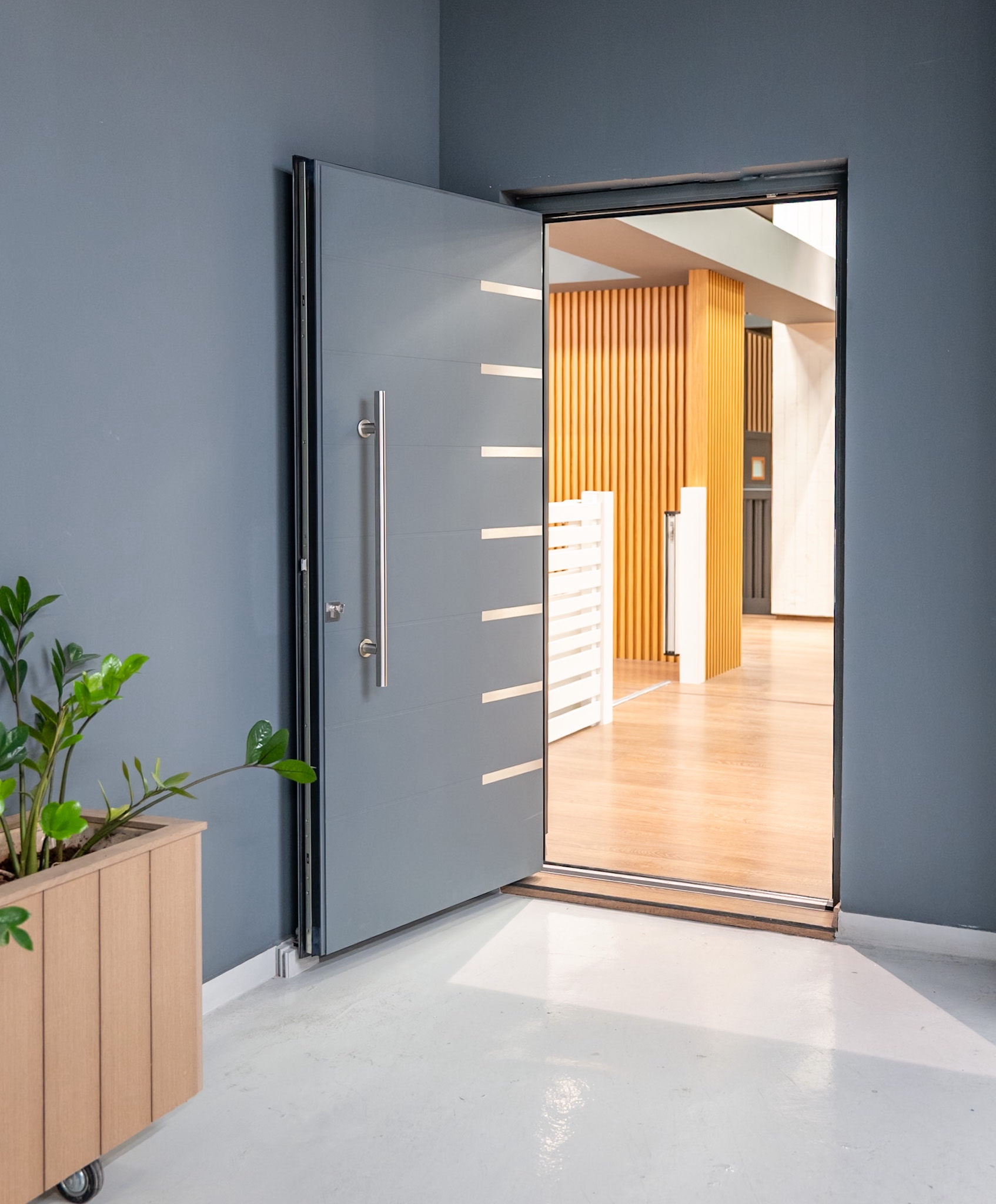
Pivot doors have moved from architectural curiosity to genuine residential option in the UK over the past few years. Instead of side hinges, a pivot front door rotates on a central or offset axis using a concealed pivot mechanism mounted in the floor and the head of the frame. This allows for much larger and heavier door leaves than a conventional hinged door can support.
The visual effect is striking, especially as the door opens and closes. An aluminium pivot door can be manufactured at heights of 2.5 metres or more and at widths that would be impractical with side hinges, creating a statement entrance door with real architectural presence. Some brands of pivot door at the very top of the market can exceed five metres high.
When open, the door leaf projects on both sides of the frame, which gives the mechanism its distinctive look. For modern new-build entrances and renovation projects with oversized openings, a pivot door is one of the most effective ways to create an architectural focal-point entrance.
At Glideline, our GPD 80 Pivot Door, provides you with a front or back door option, creating a wow-factor in any contemporary home. They are also ideal when you want a wider opening than other materials can provide. Aluminium is also the natural choice for oversized entrance doors and pivot doors because of its strength and structural rigidity.
£3,000–£10,000+ supply and fit, depending on size, material and specification.
Contemporary homes, grand entrances, modern new builds and renovation projects where the front door is intended as an architectural feature. Works best with some form of weather protection at the entrance.
A stable door is split horizontally, with the top half opening independently of the bottom. The top section swings open on its own hinges while the bottom half stays closed. This half-and-half design is useful for ventilation, keeping children or pets contained, and letting light in without opening the full door.
Stable doors are most commonly seen in cottages, farmhouses and rural properties, and they work particularly well as kitchen entrance doors. They are available in composite and timber mostly, and there are very few that also offer these in aluminium or uPVC. Composite stable doors have become popular because they combine the rustic aesthetic with modern weatherproofing and security features.
The practical limitation is that a stable door has two meeting points (the top/bottom split and the frame seal), which means there are more potential points for draughts and water ingress compared to a single-leaf door. Quality hardware and seals are essential. Few composite doors have security testing, so it is worth checking with your chosen provider.
French doors use two full-height side-hung leaves and are more typically used as rear garden doors, but they do appear as front entrance doors on Georgian and Regency homes where symmetry is a design feature. The central meeting rail can be a weakness for both security and weatherproofing if not properly specified. Look for systems with robust multi-point locking on both leaves and good compression seals along the meeting rail.
Glass plays an important role in the design, security and privacy of a front door. Obscured glass is the most common choice for entrance doors, allowing daylight in while limiting the view from outside. Laminated glass is worth considering for larger glazed areas – it includes an interlayer that helps hold the glass together if broken, supporting both safety and PAS 24 security performance.
Decorative glazing remains popular on traditional doors, including etched glass, leaded designs and sandblasted patterns. Sidelights and toplights are useful where you want more daylight without increasing the door leaf size. They need the same level of thought as the door itself, including glass specification, privacy, security and thermal performance.
A door with large glazed panels will generally have a higher (worse) U-value than a solid door, because glass conducts heat more readily than an insulated panel. This does not mean you should avoid glazed entrance doors – it means you should pay attention to the glazing specification. Double glazing with a low-emissivity coating and argon gas fill is the current minimum standard. We can help if you have specific U-values you need to meet.
Smart locking is becoming more common on front doors, particularly on contemporary aluminium and premium entrance systems. Options include keypads, fingerprint readers, smartphone apps, fobs and remote access systems. Some connect with wider smart home technology.
Smart locking needs careful specification. Not every lock works with every door system – the lock must suit the door profile, the multipoint locking system, the handle set and the cylinder arrangement. Retrofitting smart hardware to an existing door is not always straightforward. For most homeowners, smart locking is best chosen at the same time as the door rather than added afterwards.
The threshold is one of the most important details on a front door. A standard threshold gives strong weather protection but creates a step. A low threshold improves accessibility for wheelchair users, pushchairs and older occupants, and may be required under Approved Document M for new builds or accessible housing.
There is always a balance between accessibility and weather resistance. The lower the threshold, the more carefully drainage, seals and external levels need to be considered. For best results, specify the threshold with the property in mind – consider who will use the door, how exposed the entrance is, and how the internal and external floor levels will meet.
Property type: Period homes mostly suit timber or composite in traditional panelled styles. Contemporary homes tend to look best with aluminium or steel. If the entrance is the architectural focal point – a double-height hallway, an oversized opening, a cantilevered porch – a pivot door or large-format aluminium entrance door is worth serious consideration.
Exposure: A sheltered porch faces very different conditions to an exposed south-facing elevation. Coastal properties deal with salt spray. These factors affect which materials and mechanisms will perform best. Pivot doors and oversized entrance doors benefit significantly from weather protection.
Budget: Be realistic about total cost, including installation, building work and hardware. A quality composite door at £1,500 fitted will outperform a cheap aluminium door at the same price point.
Conservation areas: If your property is listed or in a conservation area, your choice may be restricted to timber or steel. Always check with your local planning authority before ordering.
PAS 24 is the UK's primary security standard for doors and windows. It tests the complete doorset – frame, leaf, locks, hinges and glazing together – against a series of physical attacks. It is a pass-or-fail standard: a product either meets it, or it does not. For new-build homes, PAS 24 compliance is required under Approved Document Q. For replacement doors it is not a legal requirement but is strongly recommended
In most cases, you need to ask for "PAS 24 specification" which may mean your door comes with laminated glass and other enhancements.
Secured by Design is a police-backed initiative that goes beyond PAS 24. Products carrying the Secured by Design accreditation have been assessed by the police crime prevention team and meet a broader set of security criteria. If security is a high priority, look for this mark. With both Secured by Design and PAS 24, do not assume your doorset has it.
Multi-point locking is now standard on quality entrance doors. This means the door locks at multiple points along the frame edge – typically three, five or seven points – rather than just at the handle. The lock cylinder itself matters too. Look for anti-snap, anti-bump and anti-pick cylinders. Three-star rated cylinders (under the TS007 standard) offer the highest level of protection against the most common lock attack methods.
A premium door badly installed will often perform worse than a mid-range door fitted correctly. Even the best entrance door relies on accurate surveying, proper frame fixing, correct packers, sealant detailing and careful adjustment to achieve the weather performance, security and thermal efficiency it was designed to deliver.
Poor installation can lead to draughts, water ingress, locking issues, dropped hinges and premature wear, regardless of how expensive the product itself is. This becomes even more important with oversized aluminium doors and pivot systems, where weight, tolerances and threshold preparation all need careful attention.
Always choose an experienced manufacturer and installer familiar with the specific type of door you are buying. A properly installed entrance door should close cleanly, lock smoothly and remain reliable for years.
A front door is a long-term decision. Most homeowners will replace theirs once, perhaps twice, in the time they live in a property. The right choice depends on matching the material, the opening mechanism and the specification to the home you have and the performance you need.
Security, thermal performance and weather resistance are important as is your design choice. Then you can narrow down by material and type based on your property style, your budget and your appetite for maintenance. If in doubt, speak to an experienced installer who can assess your specific situation.
Glideline supplies aluminium entrance door systems to trade installers across the UK, including its recently launched GPD80 pivot door. If you are a homeowner working with an installer, or an installer looking for a trade supply partner, visit our product pages or get in touch for a conversation about what might work for your project.
What is the most secure type of front door?
Some specialist steel doors can achieve higher security ratings than standard residential doors, but material alone does not determine security. A PAS 24-certified doorset, correctly installed with suitable locks, cylinders, glazing and hardware, gives the clearest indication that the complete product has been tested against common forced-entry methods.
Which front door material is best for UK weather?
Composite and aluminium both perform well in all UK weather conditions with minimal maintenance. Timber offers excellent weather resistance when properly maintained but is more demanding. uPVC handles weather well but can flex in extreme temperature swings.
How much does a new front door cost in the UK?
Prices vary significantly by material and specification. Expect to pay £800 upwards for a fitted uPVC door, £900–£2,500 for composite. Timber doors can range from , £2,000–£6,000+ for timber, £1,800–£5,000+ for aluminium, and £3,000–£8,000+ for steel or bespoke pivot doors. These ranges include supply and standard installation. All of these prices do depend on the type and brand.
What is a pivot door and should I consider one?
A pivot door rotates on a central or offset axis rather than swinging from side hinges, allowing for larger, heavier door leaves. They work best on contemporary homes with some form of weather protection at the entrance and are a premium product, typically starting around £3,000 fitted. For a full breakdown, see our dedicated pivot door guide [internal link].
Do I need planning permission to change my front door?
In most cases, replacing a front door is permitted development and does not require planning permission. However, if your property is listed or in a conservation area, you may need consent. Some local authorities restrict certain materials or styles in conservation areas. Always check with your local planning authority before ordering.
What U-value should a front door have?
The limiting U-value under Part L is 1.6 W/m²K, although many modern replacement doors comfortably achieve around 1.4 W/m²K or better.
Composite vs aluminium: which is better for a front door?
Composite offers a wider range of traditional styles at a lower price point. Aluminium offers slimmer profiles, a more contemporary aesthetic and greater structural strength for oversized doors. Aluminium is widely regarded as one of the most capable materials for entrance doors because of its strength, stability and design flexibility.
What is PAS 24 and does my door need it?
PAS 24 is a UK security standard that tests complete doorsets against forced entry. It is mandatory for new-build homes under Part Q of the Building Regulations. For replacement doors it is not legally required, but asking for a PAS 24-specific product is the most reliable way to ensure your door has been independently tested for security.
How long should a front door last?
With appropriate care, a quality composite door should last 25-30 years. Aluminium and steel doors can last 30 years or more. A well-maintained hardwood timber door can last indefinitely – there are oak front doors in the UK that are centuries old. uPVC doors typically last 20-25 years before showing signs of wear.
Can I get a front door in any colour?
Aluminium doors can be powder-coated in any RAL colour. Composite doors are available in a wide but fixed range of colours set by the manufacturer. Timber can be painted or stained in any colour. uPVC offers a more limited palette, though it has expanded in recent years. Steel doors can also be finished in any RAL colour.
This gorgeous project in South Croydon, manufacturing a minimal sliding window with matching doors. Designed by KJC Architects.
Read the Story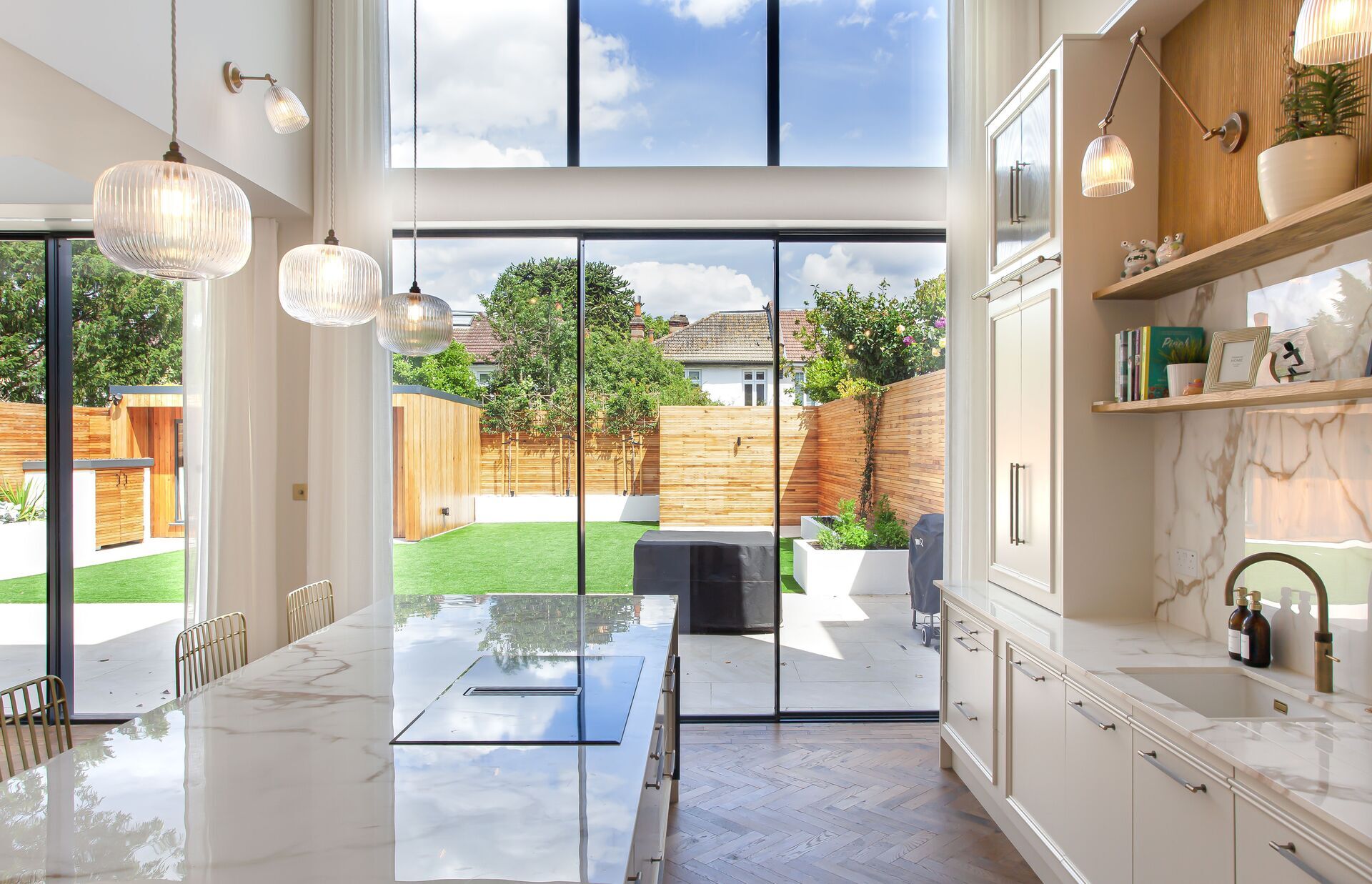
Looking for Cortizo sliding doors? Glideline manufactures and enhances Cortizo aluminium sliding doors for UK homes, weather, drainage, hardware, installation and long-term performance.
Read the Story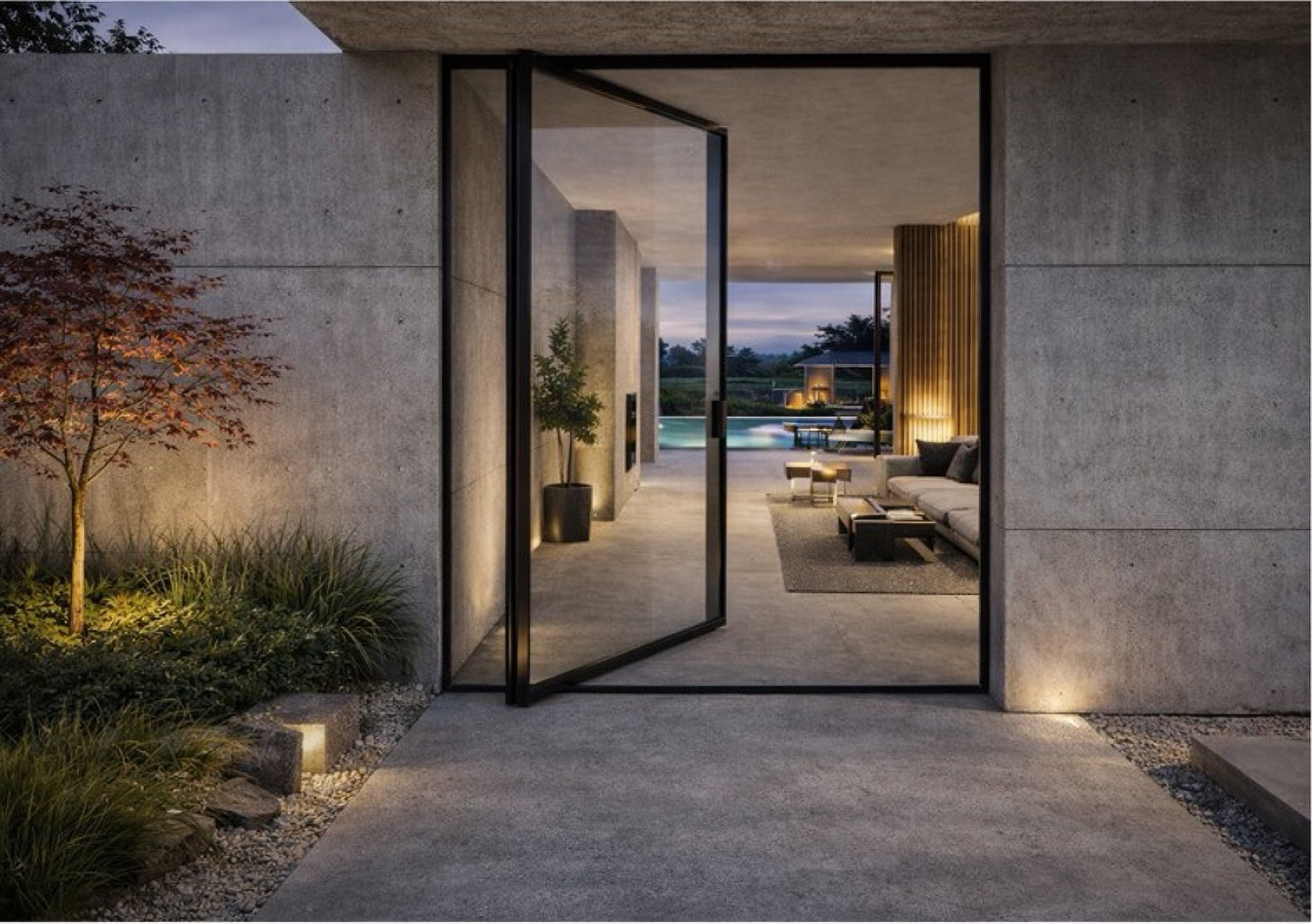
In late 2025, we launched the GPD80. Our first dedicated pivot door system, designed and engineered by Glideline. Read about the design and construction of this outstanding pivot door.
Read the Story