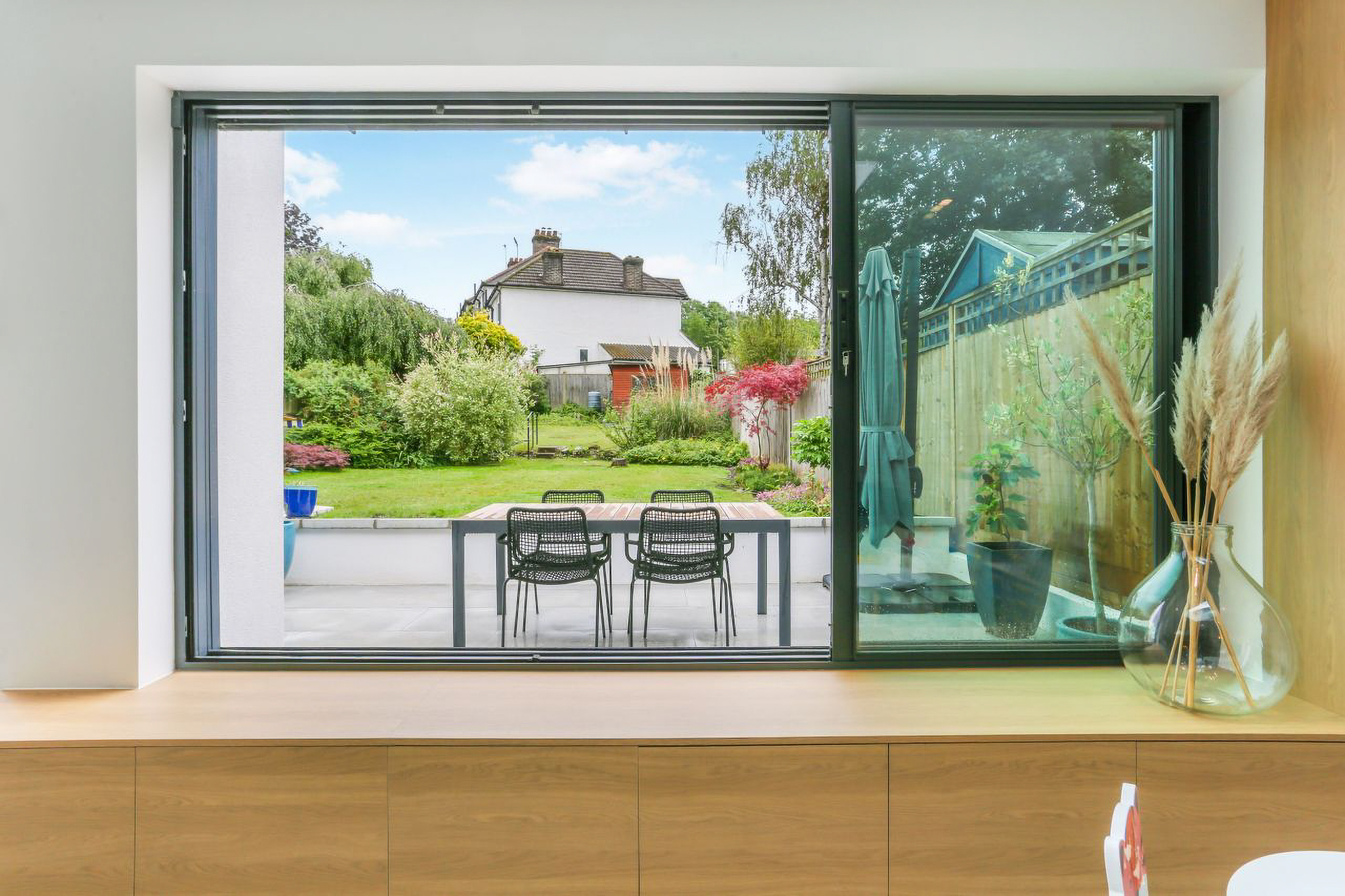
Minimal Sliding Window with matching doors in South Croydon
This gorgeous project in South Croydon, manufacturing a minimal sliding window with matching doors. Designed by KJC Architects.
Read the StoryIf you are specifying or choosing a front entrance door for a new-build or renovation project, the decision often comes down to two options: a conventional hinged door or a pivot door. Both are available in aluminium, timber and other materials. Both can meet current Building Regulations for thermal performance and security. But the way they work, the sizes they support and the way they seal against the weather are fundamentally different.
This guide compares the two systems across every area that matters for an external entrance door in the UK. We make both hinged and pivot door systems, so this is a fair comparison. Both have a place, and neither is the right answer for every project.
For a broader introduction to pivot doors, including how the mechanism works and what materials are available, see our guide to what a pivot door is.
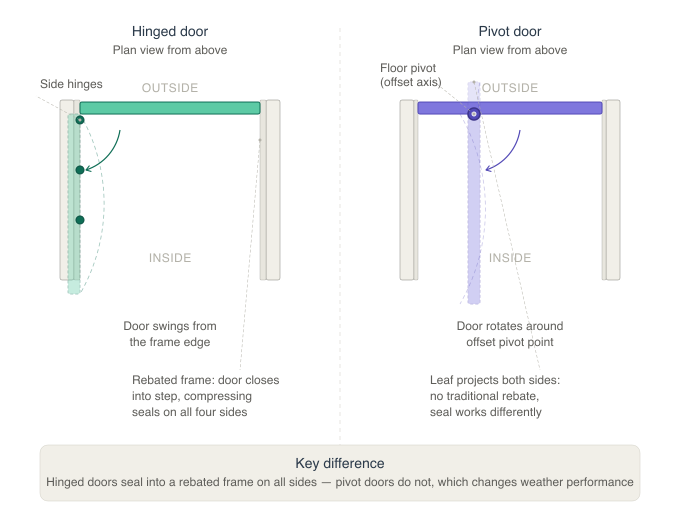
A hinged door is mounted on two, three or four butt hinges screwed into the side of the frame. The door swings on a vertical axis at the frame edge, opening in one direction only, either inward outward. The full weight of the door leaf is carried at the hinge points, which are cantilevered from the frame.
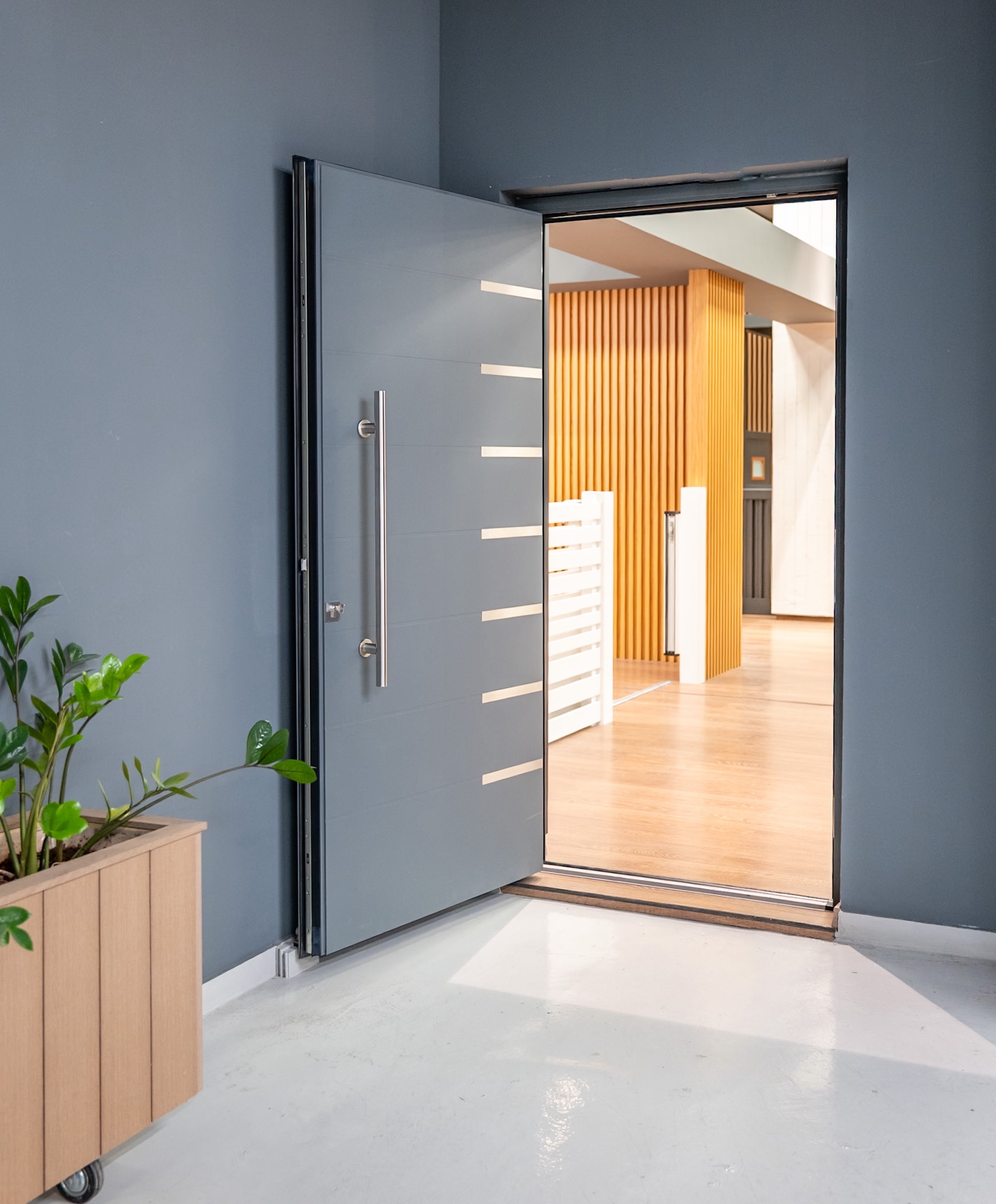
A pivot door rotates on a floor-mounted pivot pin at the bottom and a matching pivot at the top of the frame. The pivot point is typically offset from the door edge, often around one-third of the way across the panel. This means the door does not swing in a simple arc. One side of the panel moves outward while the other moves inward, creating a balanced, controlled rotation.
The practical consequence of this is that when a pivot door is open, the leaf projects on both sides of the frame. A hinged door, by contrast, only ever swings to one side. This difference affects clearance requirements, the feel of the door in operation, and importantly, how the door seals when closed.
This is the single most important distinction between the two systems for anyone specifying an external entrance door, and it deserves a clear explanation.
A hinged door closes into a fully rebated frame. The frame profile has a stepped recess, often called a rebate, that the door leaf sits into when closed. This creates a consistent seal and compression all around the door perimeter. The rebate provides a mechanical barrier against wind, rain and air infiltration, with weather seals compressed between the door leaf and the frame on all four edges.
This is a well-proven approach. The rebated frame gives a hinged door inherent weather resistance, because the door is physically recessed into the frame profile. It is one of the reasons hinged doors have been the default for external use for centuries.
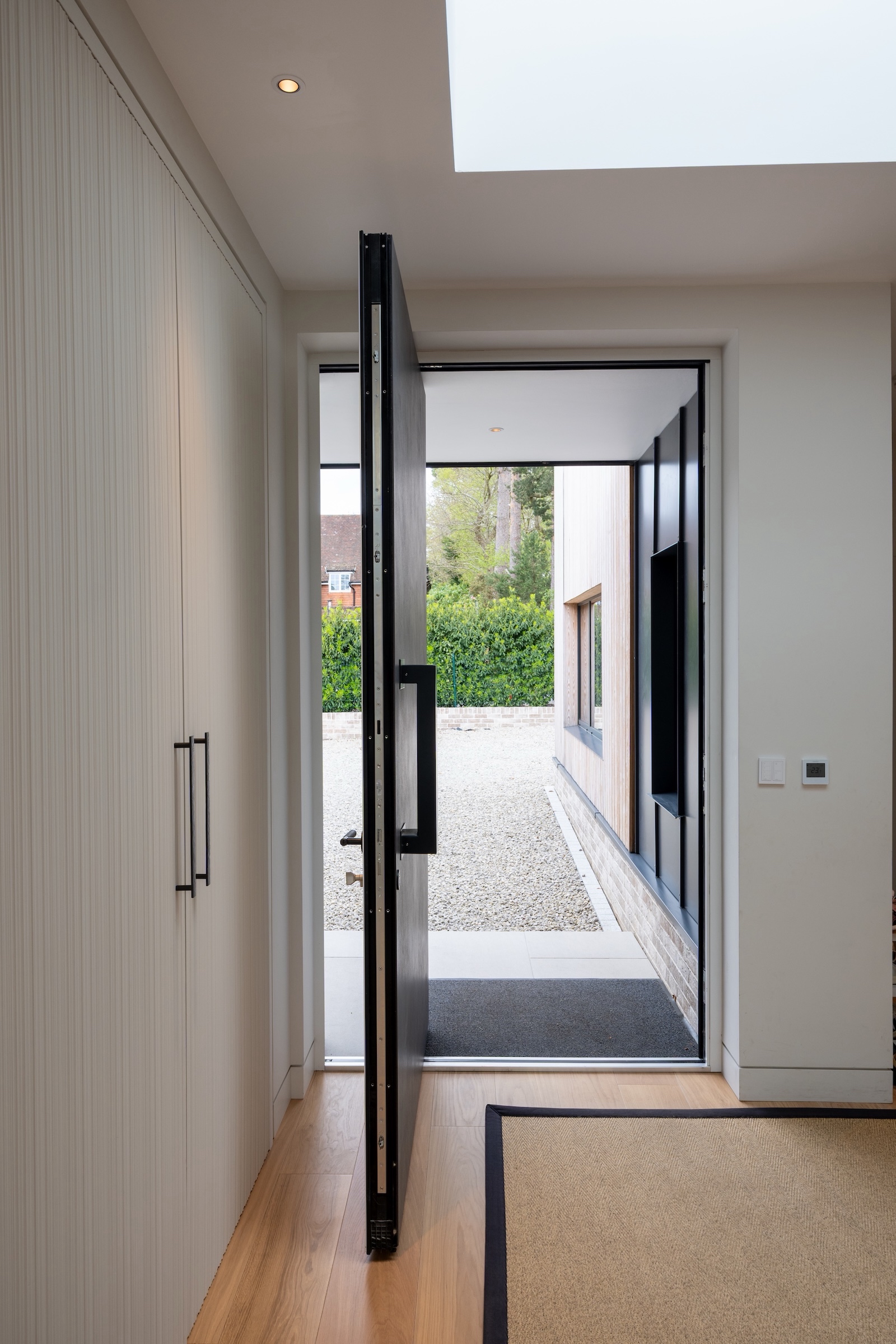
A pivot door cannot close into a traditional rebate in the same way. Because the door leaf projects on both sides of the frame when open, the frame profile and the sealing system have to work differently. Pivot doors rely on compression gaskets and weather strips rather than the mechanical advantage of a rebated recess.
This does not mean a pivot door is unsuitable for external use. Quality aluminium pivot systems are designed and tested for external applications. But it does mean the sealing performance depends more heavily on the quality of the gaskets, the precision of the installation, and the level of weather exposure at the entrance.
In practice, a well-specified pivot door with some form of weather protection at the entrance. a porch, canopy, recessed doorway or overhang will help provide some additional protection for a door of this type. A pivot door on a fully exposed elevation with no weather protection faces more demanding conditions, and in extreme driving rain the seal may not match a rebated hinged door.
This is not a reason to avoid pivot doors externally. It is a reason to consider the entrance design as a whole and to specify appropriately for the level of exposure.
This is where pivot doors offer something a hinged door fundamentally cannot.
A hinged door is constrained by the load capacity of its side-mounted hinges. The full weight of the panel hangs from those hinge points, which limits how wide and heavy the door can practically be. Most residential hinged doors are typically specified at widths up to around 1.0–1.1m. Beyond that, the door becomes heavy to operate, the hinges and frame are under significant stress, and the door may begin to drop over time.
A pivot door transfers the weight vertically through the floor pivot rather than cantilevering it from the side. This changes the structural equation entirely. Panel widths of 1.5m and beyond are practical, and some aluminium pivot systems support panels over 2.0m wide. Heights of 2.5m or more are standard, and at the top end of the market, some pivot door systems can exceed five metres high.
For projects where the entrance is designed around a large, imposing door panel. Full-height glazing, oversized solid panels, or architectural entrances intended to make a visual statement. A pivot door is generally the most practical way of supporting these extreme panel sizes.
Despite their size, many pivot doors feel surprisingly light in operation. Because the weight is carried vertically through the pivot mechanism rather than hanging from side-mounted hinges, a large pivot panel can often be opened with less effort than an equivalently sized hinged door.
Both hinged and pivot doors can achieve PAS 24 certification, the UK standard for enhanced security in residential doorsets. The test assesses the complete doorset, frame, leaf, locking system, hinges and glazing, against a series of physical attack methods. It is a pass-or-fail standard, and the criteria are the same regardless of the opening mechanism.
Hinged doors typically use multi-point locking systems with three, five or seven locking points along the frame edge. The rebated frame contributes to security by making it harder to lever the door away from the frame.
Pivot doors use sophisticated locking systems integrated into the door leaf and frame, with many systems incorporating multi-point locking.
Quality aluminium pivot systems are designed with locking points that engage into the frame at multiple positions, and PAS 24-certified pivot door systems are available. The quality of the lock, the cylinder and the overall doorset matters more than the opening mechanism alone.
For both systems, anti-snap, anti-bump and anti-pick cylinders rated to TS007 three-star should be specified as standard on any external entrance door.
Both door types can meet current Building Regulations requirements for thermal performance when specified correctly. The key factors are the frame material, the thermal break (in aluminium systems), the glazing specification and the panel construction.
A thermally broken aluminium hinged door will typically achieve U-values in the range of 1.0–1.4 W/m²K depending on the glazing and panel configuration. A thermally broken aluminium pivot door can achieve similar or better figures; some systems achieve U-values below 1.0 W/m²K with triple glazing.
The pivot mechanism itself does not inherently compromise thermal performance. What matters is the quality of the thermal break in the frame, the seal compression when the door is closed, and the glazing or panel specification. A well-engineered pivot door with an 80mm thermally broken profile and triple glazing can outperform many standard hinged doors on pure U-value.
A hinged door is the simpler installation. The frame is fixed into the structural opening, the hinges are screwed to the frame, and the door is hung and adjusted. Most experienced door installers can fit a hinged entrance door efficiently, and the tolerances are relatively forgiving.
A pivot door requires more preparation and precision. The floor pivot must be set into the floor slab or threshold at the correct position during the build phase. This needs to be planned before the floor finish is laid. The top pivot is set into the head of the frame. The panel must be balanced on the pivot axis, so it operates smoothly without drifting open or closed.
Getting the floor pivot position wrong is difficult to correct after the floor is finished, which means coordination between the builder, the floor contractor and the door installer is essential. The structural opening also needs to be prepared to tighter tolerances than a standard hinged door frame.
The UK pivot door market is still relatively young, and not every installer has experience with pivot systems. Choosing an installer who has fitted pivot doors before is important. The mechanism is not complicated, but the preparation and adjustment are less forgiving than a hinged door.
Both door types require similar maintenance when specified in aluminium: periodic cleaning of the frame and hardware, lubrication of the locking mechanism, and inspection of weather seals.
The pivot hardware itself, the floor and top pivots is a mechanical component that needs to support the full weight of the door over its lifetime. Quality pivot mechanisms are designed for this and should operate smoothly for decades, but the hardware quality varies significantly between manufacturers. The quality of the pivot mechanism and overall manufacturing quality is essential to getting a reliable door that will perform faultlessly for years.
A hinged door's butt hinges are simpler mechanical components with a long track record. They can be adjusted or replaced relatively easily if needed. Pivot hardware replacement is a more involved job, which reinforces the importance of specifying quality hardware from the outset.
A hinged entrance door is the more affordable option at every comparable specification level. A quality aluminium hinged front door typically costs £1,800–£5,000 supplied and fitted, depending on size, glazing and specification.
A pivot door is a premium product. Typical costs range from £3,000 to £10,000 or more, supplied and fitted, depending on the panel size, material and specification. The specialist hardware, the larger panel sizes and the installation complexity all contribute to the higher cost.
This is not a like-for-like comparison, because a pivot door is usually specified where a hinged door cannot achieve the desired scale or visual effect. The cost premium reflects the engineering, not just the mechanism.
The opening is a standard width, up to around 1.1m. A hinged door is the practical, proven and cost-effective solution for most UK residential front entrances. It seals into a rebated frame, works with the widest range of hardware and locking systems, is straightforward to install, and every door installer in the country has experience fitting them. For a standard entrance on any property type, a well-specified hinged door is the right choice.
The project calls for something a hinged door cannot deliver. That usually means an oversized opening, typically 1.2m wide or more, where a large, heavy door panel is part of the architectural design. Pivot doors suit contemporary new builds, renovation projects with statement entrances, double-height hallways, and properties where the front door is intended as an architectural focal point. They work best with some form of weather protection at the entrance and with an installer experienced in pivot systems.
There is no universal answer. Both systems are well-engineered solutions for different situations. The right choice depends on the opening size, the design intent, the level of weather exposure, and the budget.
Glideline manufactures both hinged and pivot entrance door systems in aluminium, designed for trade installers across the UK.
The GPD80 is our aluminium pivot front door, supporting panel sizes up to 2.1m wide by 3.0m high, with an 80mm thermally broken profile, U-values from 0.77 W/m²K with triple glazing, and PAS 24 security testing. It is designed to be straightforward to order and less complex to fit than many pivot systems.
The GR49 is our aluminium residential hinged door, available in a wide range of configurations for standard and oversized entrance openings.
For a broader overview of how pivot doors work, see our guide to what a pivot door is. For a full comparison of front door materials and types, see our complete front door guide. Or explore the full Glideline door range.
This gorgeous project in South Croydon, manufacturing a minimal sliding window with matching doors. Designed by KJC Architects.
Read the Story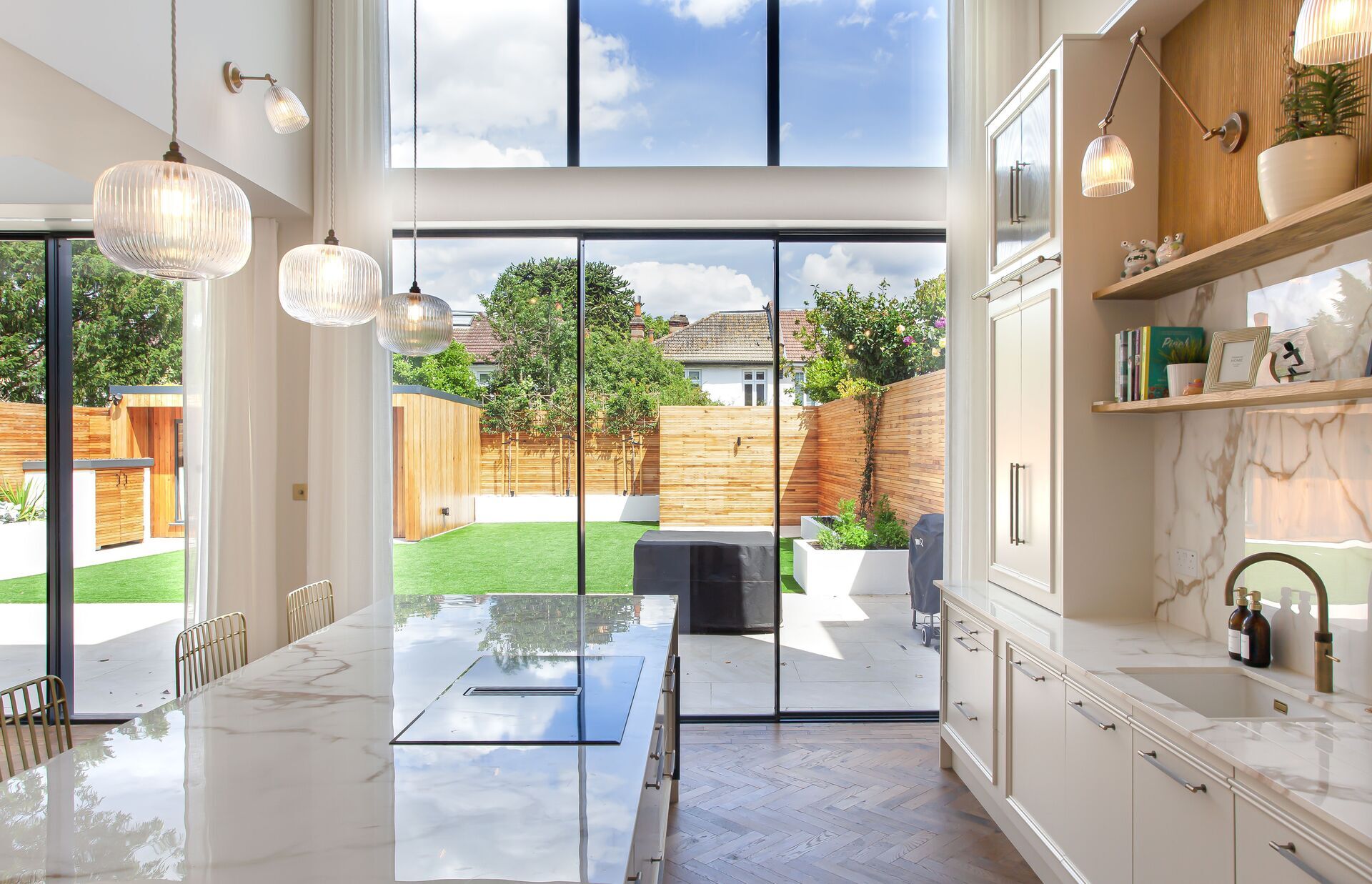
Looking for Cortizo sliding doors? Glideline manufactures and enhances Cortizo aluminium sliding doors for UK homes, weather, drainage, hardware, installation and long-term performance.
Read the Story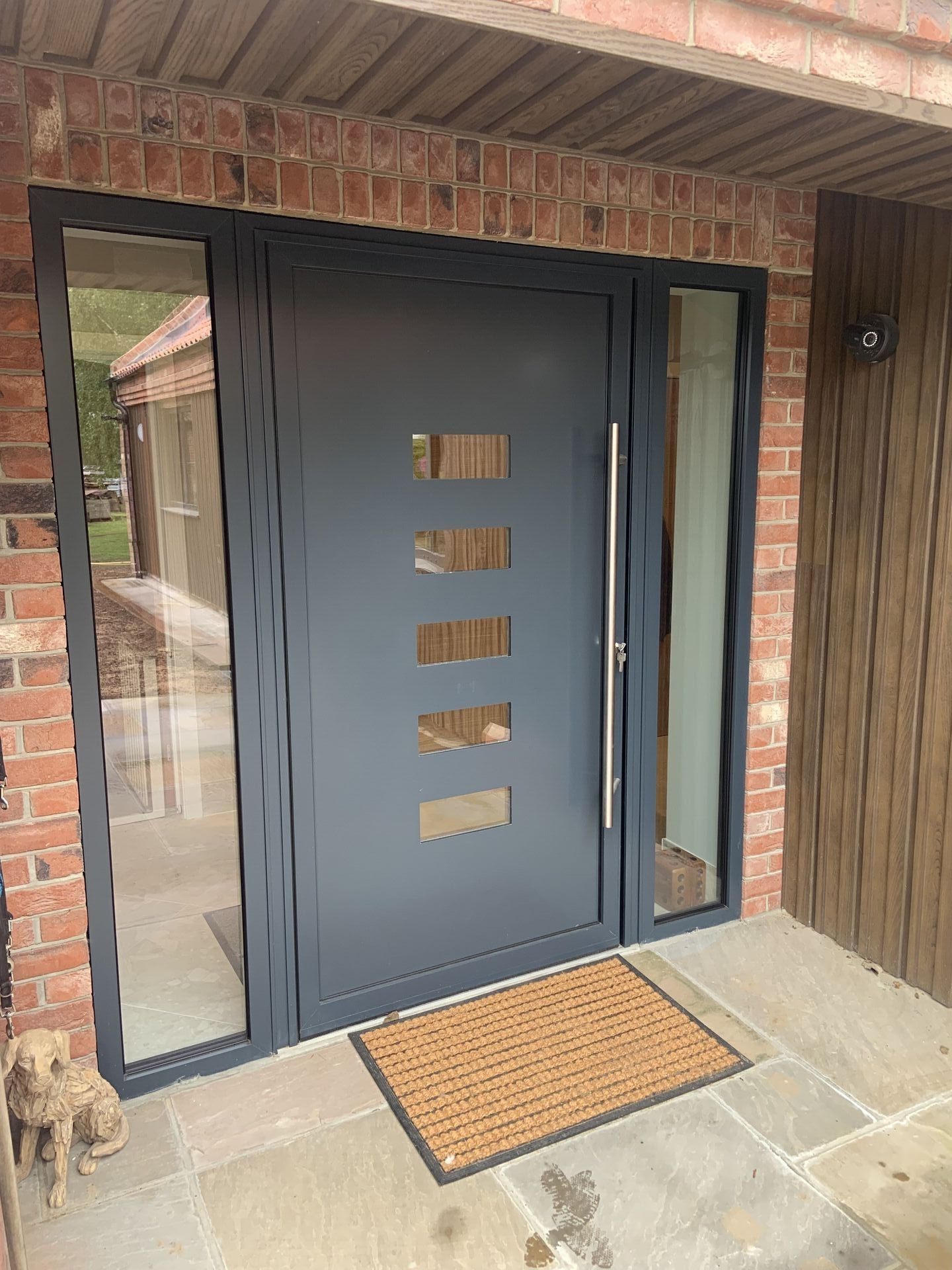
A Complete Guide to Types, Materials and what to look for when considering a new front door.
Read the Story